

WOOL: Chapter 6
One product designer's quest to make his own backpacking gear without petrochemicals

Locals! If you’re in the Pacific Northwest, my friend Pony is hosting a wool processing workshop August 2 & 3 at his farm in Astoria. Visiting artist Julia Hames will teach you how to turn freshly shorn fleece from Pony’s Romney sheep into fiber art. More info here.
As this newsletter hits your inbox, I’ll be running down my final checklist before leaving for a backpacking overnighter on Mt. Hood. Two friends and I are hiking into a lakeside backcountry site for one quiet night in the woods. All week I’ve been prepping and playing with my gear, from my new Alpha Direct fleece to my years-old frame backpack. These days, as I write about gear, it’s hard for me to ignore the fact that nearly every piece of outdoor gear is made from petroleum-derived materials. If you remember, two chapters ago, we looked at how and why synthetics became ubiquitous in apparel. It’s intertwined with our lives now.
But for those who believe it’s impossible to remove synthetics from performance clothing, may I introduce you to Tom Bonamici. He’s an assistant professor at the University of Oregon in Portland teaching sports product design courses at the undergrad and grad levels. Recently, he finished creating a whole collection of backpacking gear using zero petrochemicals. Only wool, cotton, linen, etc.
Because about three-quarters of his collection is made of wool, I thought he’d be the perfect candidate for this next chapter in the wool series!
A little bit of Tom’s background: He grew up in Eugene and from a young age, got into rock climbing, then backpacking and mountaineering. In undergrad at Dartmouth, he joined the outing club and was introduced to the more traditional approach to the outdoors—heavy canvas, rugged Klondike miner ethos. While studying urban geography and architecture, he also spent time in the wood shop learning timber framing and furniture building. Around the time he was considering grad school, he taught himself to sew and co-founded the heritage apparel brand Archival Clothing with a friend. That gave him the drive to study product design at Pratt Institute in NYC while the brand gained an international following, landing in boutiques across Japan, Scandinavia, and the U.S. After the company dissolved, he worked for Best Made Co. before returning to custom woodworking. A backpacking trip through Oregon's Wallowas convinced him to move home, and while digging out a clogged basement drain on a construction job, he received an unexpected call from U of O asking him to teach. Eleven years later, he’s a tenure track professor. Research projects like this are part of the gig.
At his studio in late May, we talked about:
why he’s being so strict about only using natural materials
everything in his kit that’s made out of wool
some common misconceptions about wool today
and the very vintage technique he used to make an ultralight tarp
Later this month, Tom will take his backpacking kit out onto the trail to test how it holds up. I’ll report on his field trip for Backpacker so stay tuned.
Our interview has been lightly edited for clarity. You’re gonna want to read it in the app or in your web browser because it’s going to appear abbreviated in your email.
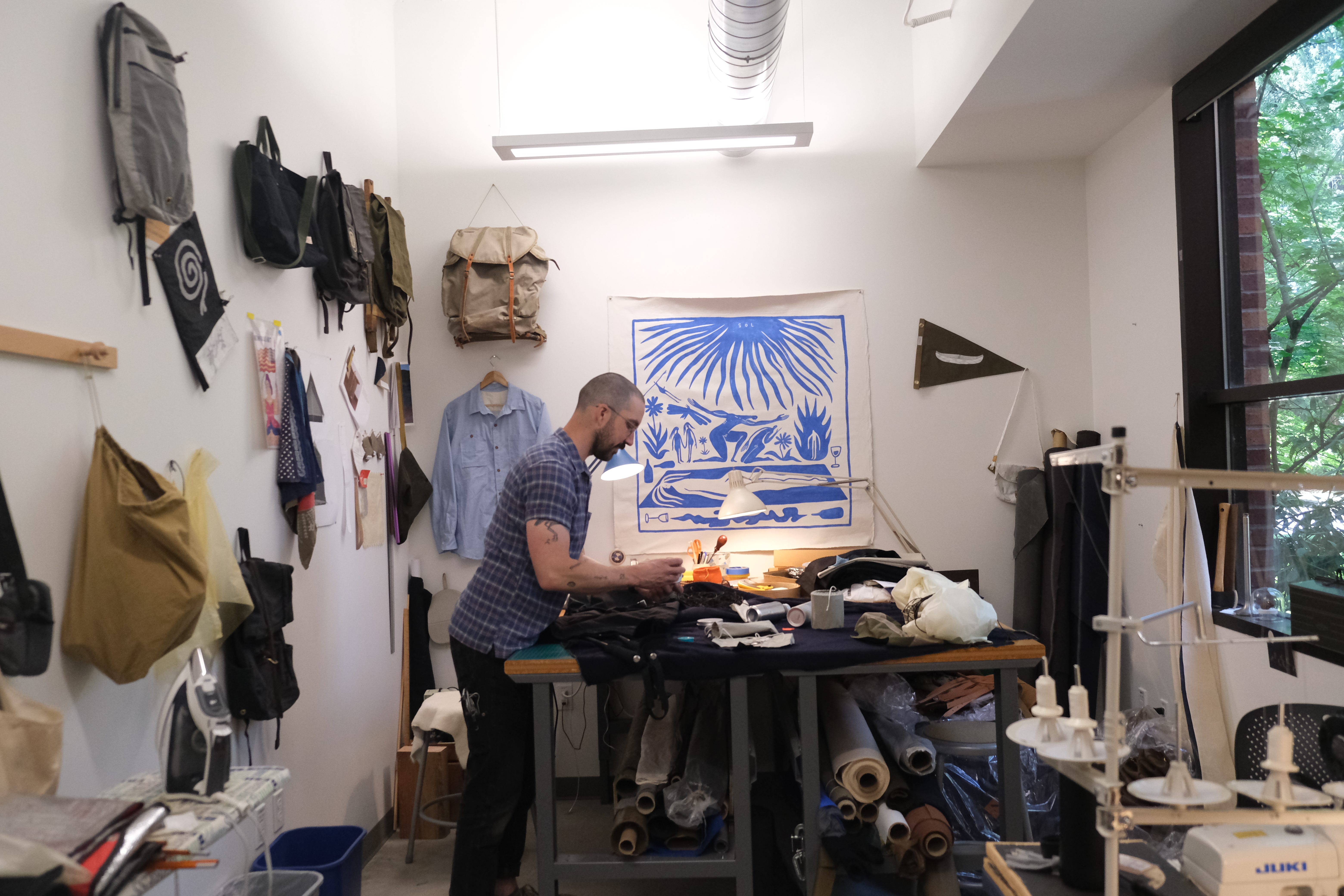
Amelia: Where are you at with your collection?
Tom: We are pretty close. Almost everything is done. The big, important things—backpack, sleeping pad, tent, quilt—all that’s done. Almost all the apparel is done with a couple exceptions. I need to make some cozy long johns out of an interesting double knit merino that Mood Fabrics told me is 100 percent. I’ll give it a lighter test to make sure. I’ve been pretty strict in keeping it 100 percent natural. I know that like, in these shoes there’s probably an adhesive somewhere that’s not bonafide. But with shoes it was such a brutal thing to figure out.
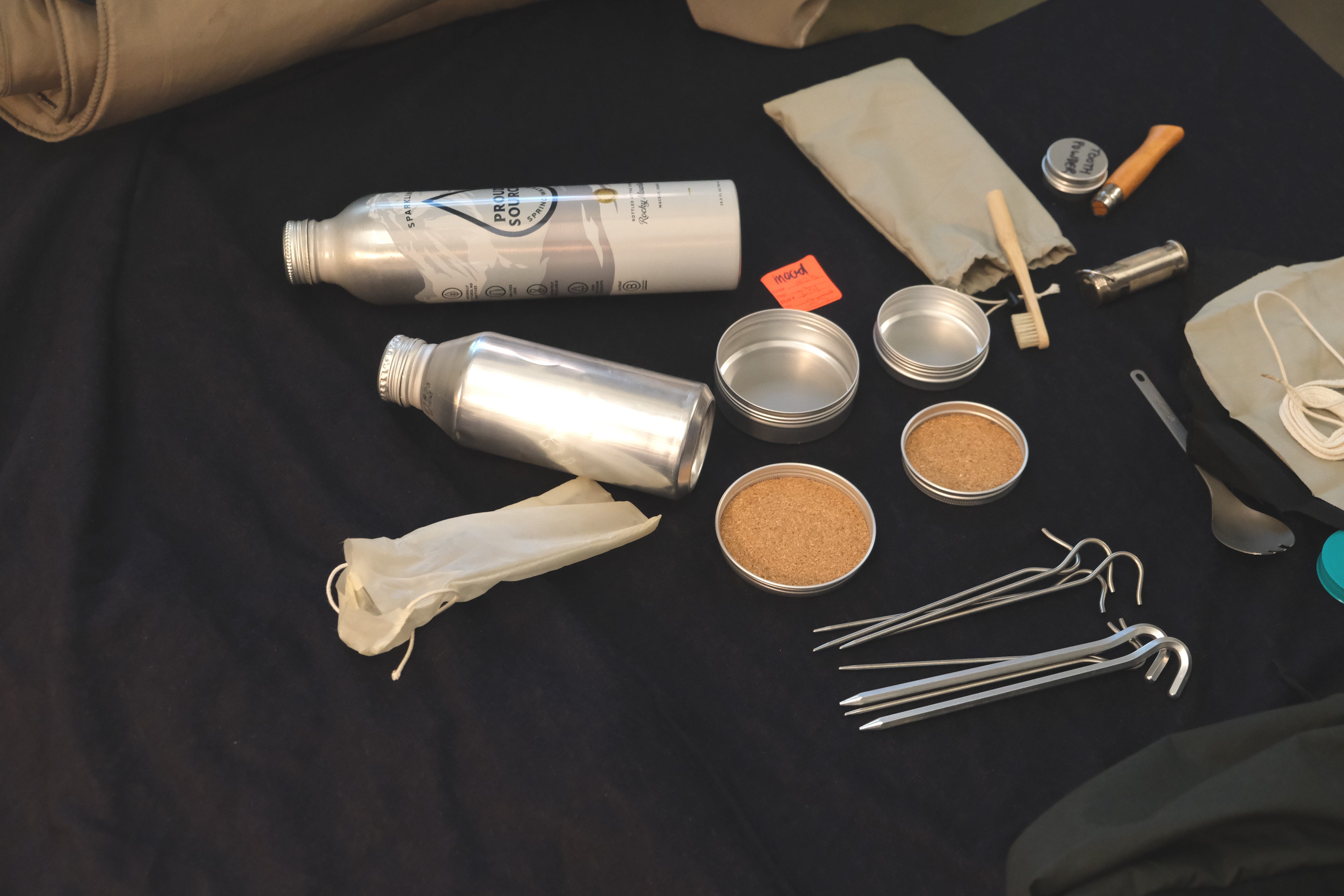
I just figured out my camp kitchen and little odds and ends for food storage. I’m making a lot of stuff sacks from silk, but then I just grabbed some bees wrap because I can wrap stuff up like a little burrito. I was trying to just sew it together and the bees wrap wax is so sticky on the sewing machine that it would just kind of take two stitches and then bog down even if I was really guiding it. I had to bind the edges so the feed could move it through.
I’ve also got all these tins. To make it seal they use this foamy stuff so I’ve been pulling that out and replacing it with cork. It’s a little ridiculous at some point, but I want to really push the idea and see how far it can go. I think that this is where a lot of weight is going to be added. My tarp weighs less than a Dyneema tarp. But like, these containers weigh so much more than ziplocs.
I’m still gonna put together a first aid kit but that gets an exception. Same with water filtration. I don’t want to get giardia for this project.
Amelia: You’re like a miner with his tin cans and little bags. Does what you’re doing feel counterculture-y sometimes?
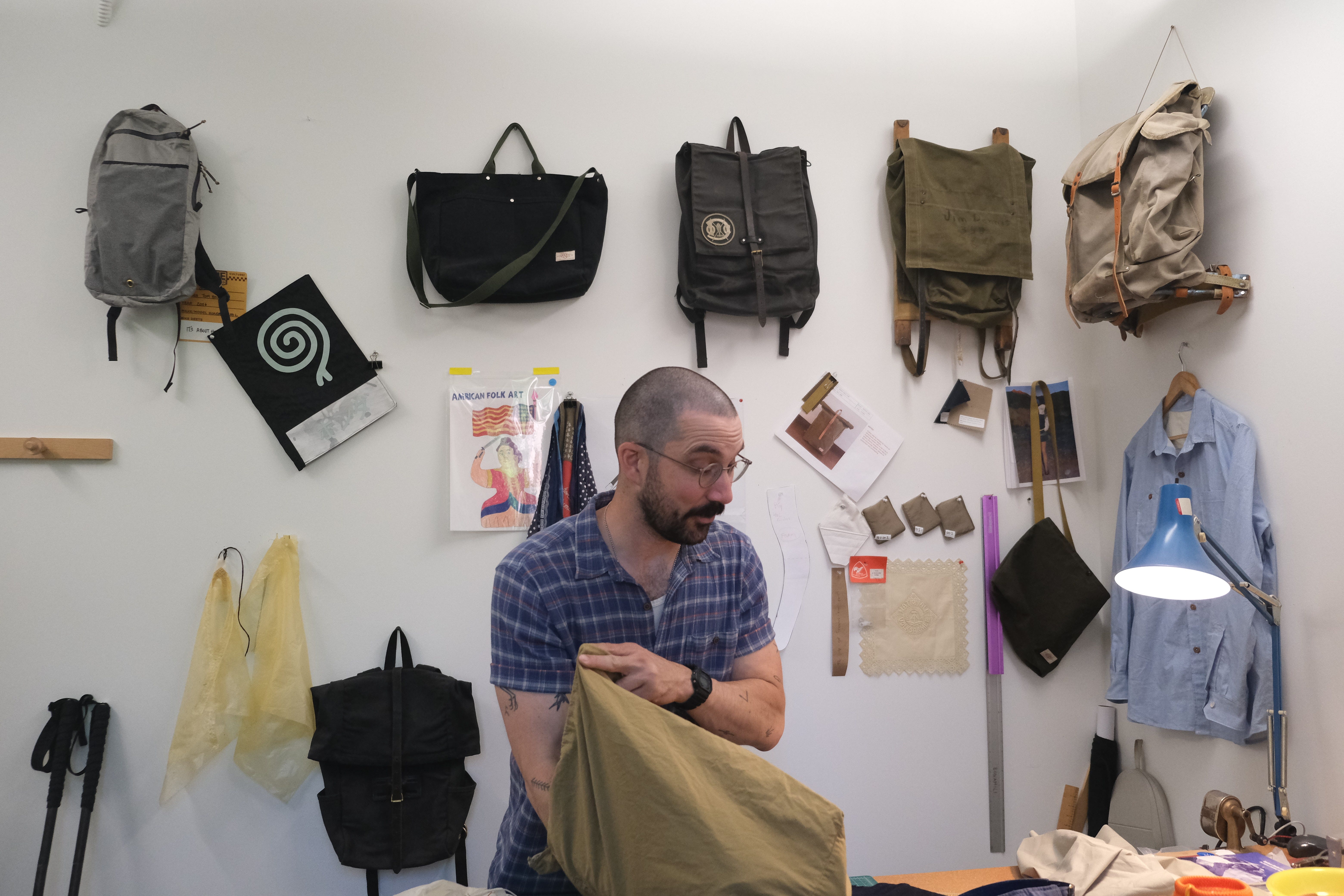
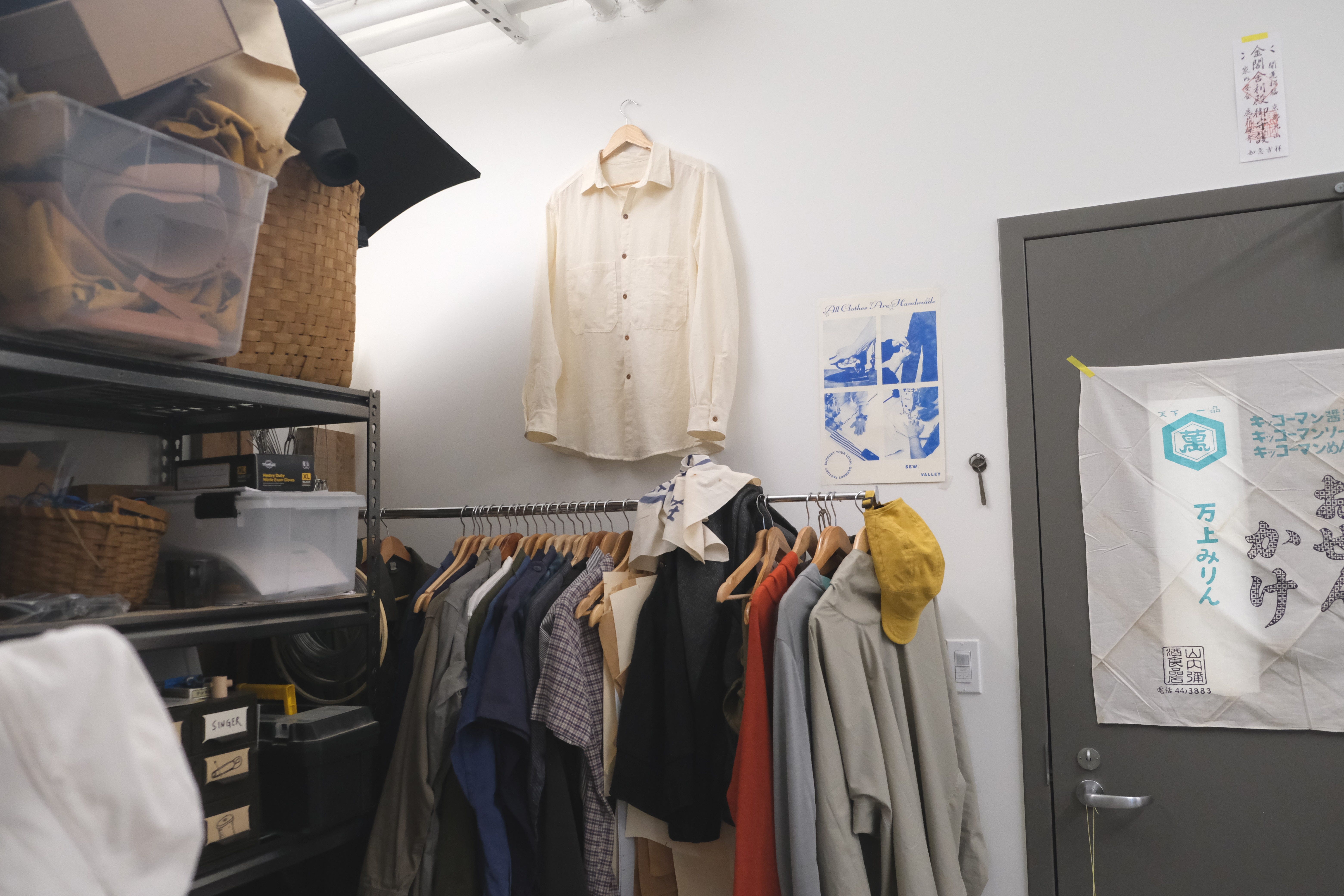
Tom: It’s counterculture, but I started the project thinking about it in a more traditional way. I knew from the start that I didn’t want to make it that Klondike miner, Filson heavy waxed cotton thing. That was never the goal. That shirt on the wall in cotton gauze and the bucket hat with the extended brim—those were the first two things I made. I kinda did a vibe check with myself and several colleagues and realized I wanted to make this as visually acceptable as possible. Relevant to the contemporary backpacker and not too far out. The point is to prove that you can in fact be completely compostable, completely biodegradable, and not use petrochemicals in the backcountry. I think it’s easier to do that making something that is visually acceptable. From 50 feet away you wouldn’t notice anything but maybe the shoes1 do not look like trail shoes.
Amelia: They look dope.
Tom: They look dope as fuck but they are not trail running shoes. Someone might— I don’t know, from 50 feet away you’re not even going to notice that the trekking poles are made from Calcutta bamboo.
Then when you start zooming in you’re like, wow, there’s a lot of natty materials here. I’m just so used to using so many plastic bags when I’m backpacking and camping. And even energy bars and all that. I don’t get that. I’ll probably make some bars and wrap them up in bees wrap.
Amelia: Tell me the end goal. What is this all leading up to? Obviously the journey is part of it. You’ve clearly learned so much in the process.
Tom: The whole goal is to have conversations around this premise and have it with as many people as possible. The potential consumer, although this is not marketplace ready, but also practitioners whether that’s fellow academic designers or hopefully it’s a lot of people who are in outdoor gear design. If that’s the goal, I need a certain number of deliverables to accomplish that goal—and some cute photographs. But I also want some real world testing. Not really data, but some anecdotal experience. So I’m gonna go on a three-day backpacking trip somewhere on the PCT or in the mountains. The point of the trip is to really test it in use and see how it goes, see what the strongest and weakest points are. I can already anticipate, like, I don’t think I’m gonna have any clothing issues. I’ve done a lot of backpacking and camping and kinda know what I’m bringing and it’s not that much different than what I already bring. Most of the time I’m just rocking merino anyway. I’m especially curious to see how the tarp holds up. I reinforced it as good as I could and was doing research on traditional sail-making techniques and how they do their patches and seams and everything. I also used this tarred linen cord to stakeout the tarp. I’m bringing some extra.
The sleeping, I think, is going to be a little rough. The sleeping pad is this sandwich of cork and felt. It’s R-value only. It is not for comfort. I’m hoping to find some soft pine needle areas. That’s gonna be a thing. Then the sleeping quilt being a denser material, less lofty for its weight, I don’t think it’s going to be a suffer fest but it’s not gonna be super warm. Also, the sleeping quilt is made with this 60/40 cotton-silk blend outer fabric. It’s so fine and so gauzy. Sleeping on the ground, I think it’s going to get a little shredded. I think it’s still totally usable. Seeing how the gear disintegrates a little bit is part of the goal. Then once I have some great photographs, this real world anecdotal experience, I’m going to show the whole collection at Dutch Design Week2 in October. That show is not market focused at all. It’s way less commercial than Milan. It’s more of an experimental, kind of philosophical show, which is great for this.
Amelia: Take me through the wool pieces.
Tom: Wow, a lot. With the backpack, the stretch pocket, shoulder pad lining fabric, and shoulder pad padding—that’s all merino. The pad is a merino felt, and the liner and stretch pocket are a merino stretch jersey. The sleeping quilt has a Lavalan3 wool batting as well as a thin layer of a merino wool quilt batting. It’s very, very thin but I wanted a little bit more insulation. It gets cold in the hills. The sun hoodie is 80 percent merino, 20 percent silk. Then I’ve got a campsite long sleeve shirt, another warmer hoodie, and underwear that are all 100 percent merino. Latex elastic. The sweater and hat are 100 percent musk ox wool (called qiviut). And then the socks are both 100 percent merino. Those are still being knit as we speak. One of my students is a really passionate knitter and I was able to pay her to knit some custom socks. I think she’s actually using alpaca to reinforce the heel and toe.
Amelia: Okay, so tons! In your research, did you find out how significant wool was to early explorers? And how did that inform what you’re creating today?
Tom: There’s such a narrative around natural fibers that they don’t belong in the outdoors. That cotton kills. There’s less of that around wool, especially with high performance merino that’s so widely available. There’s still a little bit of it. This is not really well researched, but my sense is that it tracks back to the Scott Antarctica expedition where a lot of people died4. Amundsen, however, was using Indigenous clothing tech. Basically all furs and dog teams. Scott was this stodgy British guy who was using basically all wool and gabardine wind suits, and horses. All wildly inappropriate for Antarctica. That is true, and they all died. And they very much didn’t do enough research. And the further I dug into how wool and other fabrics like cotton were used technically, especially by early mountaineers, I found that most of them were wearing wools and they worked really well. So I think, as always, the story is more nuanced than “the old stuff is bad and the new stuff is good.” There’s a lot of performance inherent in this stuff.
I also found that even with wool, people were achieving crazy light weights even over 100 years ago. There’s a cyclist who was a lightweight fanatic. His base pack weight was 10 pounds in 1910. That’s what we’re shooting for now. That guy was also probably tougher than we are, probably sleeping straight up on the ground. But the passion for lightweight is as old as the desire to recreate outside, and people were pushing it really hard and able to achieve it with wools and cottons.
It was clear to me from the start that I was going to use wool for the entirety of this project because of its thermoregulating capacity, its strength, and just how versatile the fiber is. The part I’m least worried about is whether or not the wool is going to perform because I already use it. It’s just the best.
Amelia: A little more on wool. Do you think there are misconceptions about wool today?
Tom: Yes, a lot. One is that it’s expensive. The second is that it’s itchy. The third is that it’s heavy. And fourth is that it keeps you warm when you’re wet but is very, very slow to dry. The first: Yes, it is expensive. And especially, setting my project aside, if you’re using a blend, so maybe it’s got 10 percent synthetic content, it’s going to last so much longer. It stinks less, which means you can wash it less, which means it gets abused less. Washing is the most brutal thing we do to our clothes. Even if it costs twice as much, you can wear it for more than twice as much. Your cost per wear is lower.
Second: Itchy. Yes, there are itchy wools out there and there are also a lot of not-itchy wools out there like the superfine microns. I wear wool underwear every, single day. Different people have different tolerances, and yeah, some people might find anything itchy. That’s their body and their sensitivity. But I think for the vast majority of people, once they get their paws on some really nice merino, they are so happy. Also there are a lot of wool applications not next to skin.
Third, heavy. It is maybe a little bit heavier than some comparable synthetics. I’ve made three or four sleeping quilts out of a synthetic loft and it is lighter. But for the type of wool I’m using when I’m backpacking, it’s really negligible. Because wool doesn’t stink, you can have fewer clothes and be comfortable and hygienic and fresh.
The last misconception is that it’s slow to dry. This, I think, is a similar argument to how cotton is slow to dry. Wool keeps you warm when it’s wet; cotton does not. But that doesn’t mean cotton has no place in the backcountry. I love backpacking in a cotton T-shirt. It’s really comfortable. It gets cool when it’s wet, which is a feature not a bug most of the time, if you’ve got something dry to change into. But for wool, I also think it’s just got overblown. When is the last time you were backpacking and you got totally soaked?
Amelia: The Wallowas in September. Haha. My rain shell completely wetted out.
Tom: Brutal. Synthetics will also wet out and take time to dry. Wool takes a little bit longer to dry. How much of a huge deal really is that? If it’s that bad, you’re probably gonna bail. (Editor’s note: I did.) Most of us are not doing expeditions where it’s actually that dangerous to be wet. That’s pretty uncommon if you think about the people going to REI, buying their gear, going on a few trips per year. They’re gonna be fine.
Also, lab results are not the same as field results. You can test wool with a robot in the lab and say it’s not as abrasion resistant, it takes longer to dry than synthetic. I haven’t run into that robot in the woods. I’m interested in subjective experience. I think that’s really real and valid. If your heart feels better wearing wool, then it’s worth whatever tiny difference there is.
Amelia: We’ve covered wool. But when it came to your linseed oil and taffeta tarp, you told me there wasn’t a playbook for that. How did you figure it out?
Tom: The biggest gap was a lightweight waterproof material that I could use for a shelter. We’re so lucky to have the synthetic materials we have. I’m not anti-synthetic. I think they’re so badass. X-Pac. This is 0.67 Dyneema that’s also camo. It’s the coolest shit ever. I made a tarp out of this. I think I’m gonna try to make a little solo tent with what I’ve got left. It’s amazing. Waterproof, so strong, but it’s also made 100 percent of oil. When you’re trying to avoid that, it’s a tall challenge.
I went to the Utah State University Outdoor Recreation Archive5 to try to find tents. What kind of shelter could I dig up? What kind of materials were they using? Most of the tents were basically cotton canvas or a plain woven canvas. They would sometimes stipulate Egyptian cotton, which just meant long staple. Sometimes they would say closely woven. But that’s about all the information I had. They weren’t giving me thread count, yarn gauge. I didn’t really find anything at the archive but cotton. Can you use cotton? Yes, you can use cotton. In fact, some bushcraft people will get a high thread count cotton sheet and then use that as an A-frame. If you pitch it pretty steeply and you don’t touch it, then the water runs right off. If you touch it, it compresses the fibers enough that the waters bridge through and it’ll start running down on the inside. In more research I found more about this, like stories about kids camping with dad in the ‘30s and ‘40s, and it was a thing to poke the tent and watch the water run through on rainy days. That was in some children’s book. You’ve gotta find what you can.
What stumped me on this was that the lightest weight tent I could find in the USU archive, in those old Abercrombie & Fitch catalogs, was about 3 pounds. That’s still too heavy. I’m trying to go light as fuck. I kept digging, more on the internet. I was able to find this book by Clinton Dent about Albert F. Mummery6, a British mountaineer active in the Alps, a generation after the Matterhorn first ascent. He developed the Mummery tent out of silk and oil, and it weighed 2 pounds. It used ice axes and was basically a tiny, little pop tent, really small, probably very uncomfortable. Then I start digging in on oil and silk.
I worked with my reference librarians here at the university, and I was just stumped. We couldn’t find shit. I like reading old British novels sometimes, and I had maybe seen on Sherlock Holmes an oil and silk bag or something like that. But never any details. We just couldn’t find anything. There isn’t a YouTube video, no white paper. I figured it’s probably linseed oil because that’s what was used to make a traditional rain slicker for a sailor, which is why they’re yellow. I know, as a woodworker, it’s a polymerizing oil. If it’s applied thinly enough, it will polymerize and create a natural plastic that is still totally biodegradable. A French polish on a piece of furniture is just a million layers of thinly applied walnut oil. It ends up being quite a remarkably durable finish. I’ve used it a bunch in woodworking so I thought I’d give it a try. Then I needed to determine a base fabric. I had always heard of silk, but what construction? By digging in the fabric glossary, I figured taffeta would be a good way to go. It’s pretty widely available, and it’s about as dense as it gets. Tightly woven, meant to be a little bit crinkly.
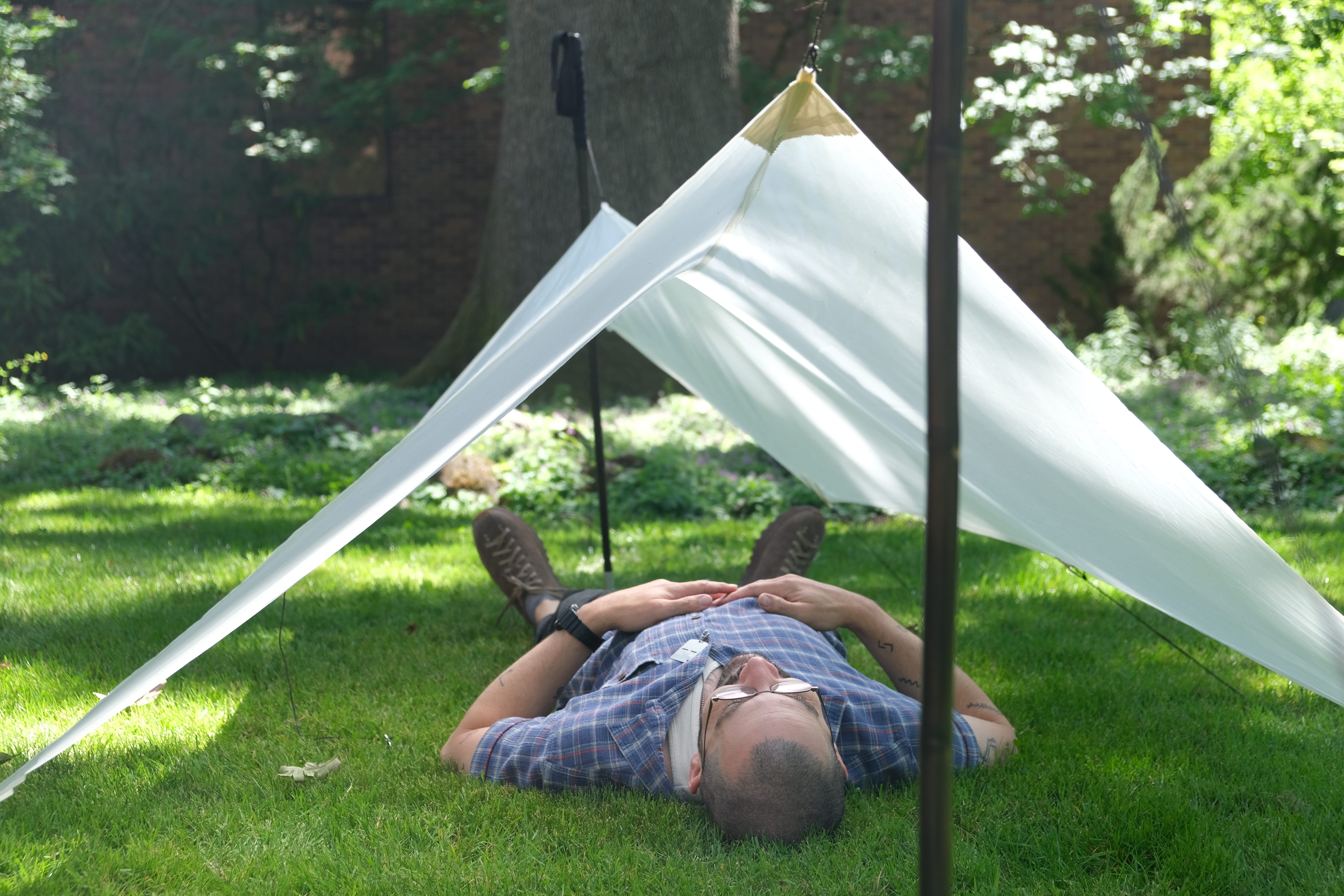
In experimenting, some of it turned out way too sticky and gross. But eventually I found a technique that worked pretty damn well. I got enough saturation without too much, and also allowed for one coat instead of two. As soon as I started doing two coats, it was really hard to control how much linseed oil stayed on versus came off. So then I treated my yardage and it’s pretty good. It’s 9 feet long, so it would be 6 yards. This tarp, I think, weighs under a pound. It’s a small, solo tarp.
Amelia: Just a tent for Tom. Maybe not his toes though.
Tom: I did make it a little longer so it should fit my toes, but it’s still small. It’s even tapered so it’s a little smaller at the head. But it is, I think, a functional waterproof, fairly water resistant tarp. Pray for good weather. It’s lighter than the Dyneema tarp I made. It yellows as it ages. Instead of folding or rolling, which can create creases even in a polyurethane coating, I’m just crumpling it.
But it is not strong. So I am using catenary lines7 to spread out the force on the seams as much as possible. I used a fairly wide single, top stitch, flat felled seam ridge, which is gonna hold. Then I was doing staggered reinforcements where the ridge is staked out and tied in place. I should’ve probably used more zig-zag stitching—that’s a big thing in sailing—but I also didn’t want to over-perforate the fabric. With a low profile, catenary lines, and being careful about campsite selection, I think it’s gonna be totally fine.
Amelia: Which you should do anyway. I just wrote a story about extending the life of your tent, and choosing the right campsite is part of that. You’re supposed to consider things like that for synthetics as well.
Tom: Ideally you do.
Amelia: But we’ve gotten away from taking care of our things or caring about how they’re made because we can just go buy a new one at the REI Memorial Day Sale. Ha!
Tom: Exactly. I’m okay with all of these products demanding a little bit more care and attention. But I’m a Virgo, so I don’t mind being a little fussy on that stuff.
The material was actually really easy to sew. It cuts really cleanly. You don’t even need to do a double turn hem. I did just for strength, but the oil has impregnated the material so much that you don’t have any unraveling. It’s cool.
Amelia: That process—you did it in your yard, I’m guessing.
Tom: I did it in a bucket downstairs actually. I thinned it with a little natural turpentine, which is basically tree sap distilled like alcohol. The natural turps thin out the linseed so it flows a little bit better. The turpentine is stinkier than the linseed oil. The linseed oil is not that bad. It’s flaxseed oil, same stuff you’ve got in your fridge. I basically have a ratio, and I blend the turps and linseed oil, dunk and saturate, and then squeeze out really, really well. I had a couple special ways of squeezing it out best. Then hung it up to dry. By hanging it on its edge, there’s some flow down as it dries, which means the very bottom selvedge gets sticky. I just snipped that off. I also found that it didn’t starve the upper areas. The drip didn’t drip too much. I dried it in that room with a fan going and vent hood for four days. It took a while to dry, but it’s not sticky and gross.
One of the things I learned is because I hung it on a clothesline, the fabric got a curve and that curve stayed. I used our fancy CNC cutting table to cut out these catenary curves. I patted the fabric down on the table, and the other corner goes verp. Patted down the other corner, and the other side goes verp. It warped. Next time I do this, I’m going to have to figure out a rigid hanging system.
Thank you, Tom! Wish him luck at Dutch Design Week! I’ll be seeing him sooner than October because I’ll follow up on his field test for a Backpacker assignment.
And thanks to you for making it this far in the article—and in the wool series. Next up is a profile of a new wool mill in Portland, centered within the Pacific Northwest’s textile history. Beyond that, I’ll be rounding out the series with reporting on wool in performance wear—including more about my visit to the USU Outdoor Recreation Archive!
Dope ass shoes: https://www.feitdirect.com/
https://ddw.nl/
https://www.lavalan.com/
https://nzaht.org/conserve/explorer-bases/scotts-hut-cape-evans/history-of-scotts-expedition/
The Outdoor Recreation Archive is where I received a fellowship to visit this April. The good dudes over there are curating an archive of old outdoor industry paperwork, from catalogs to design notes to books.
https://archive.org/details/mountaineering00dentiala
https://sectionhiker.com/flat-tarps-vs-catenary-cut-tarps/
Wow! This was so cool! Great interview Amelia!