

WOOL: Chapter 2
The world's oldest woolen garments: a pair of pants from China and a skirt from Denmark

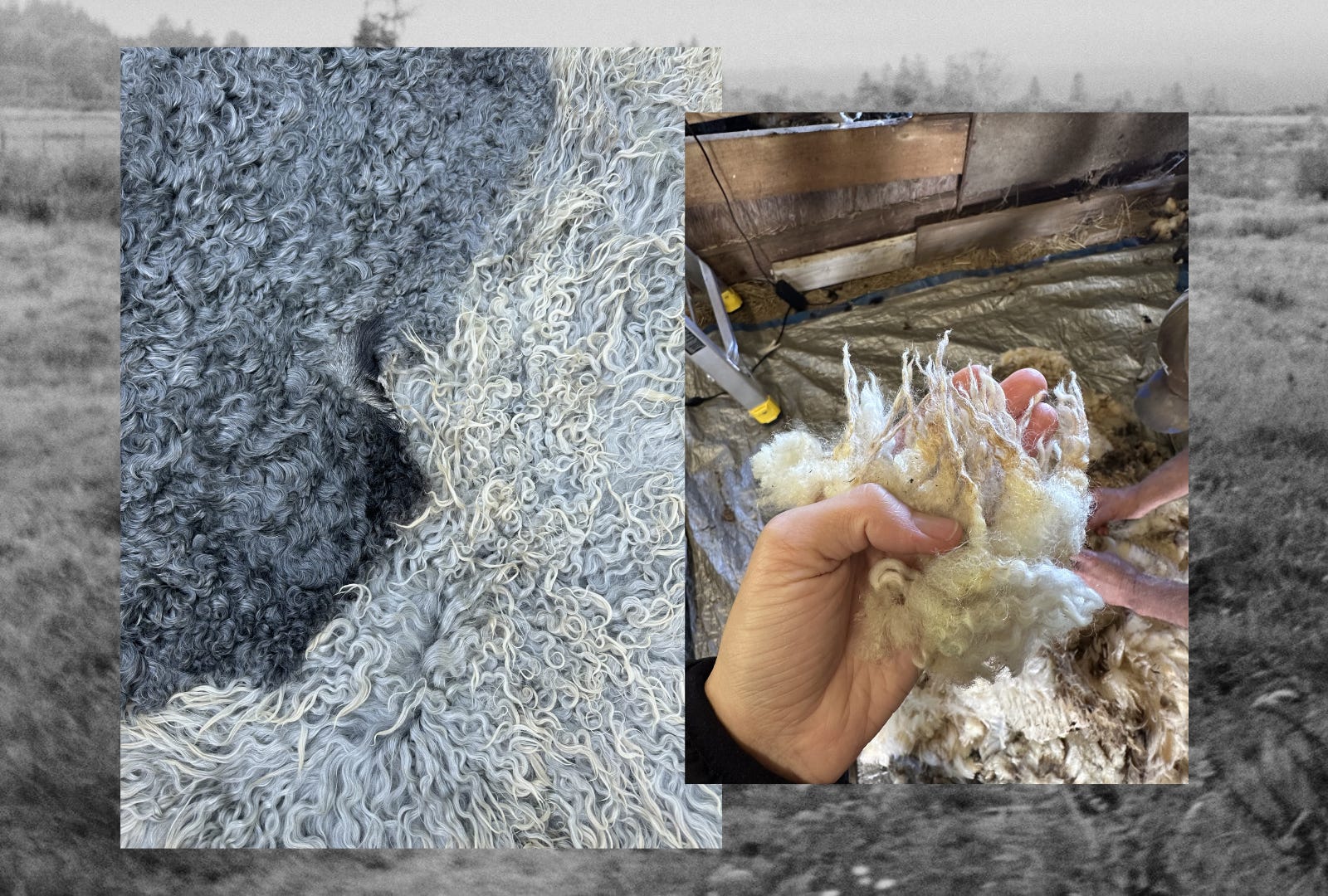
Let’s talk about wool some more, shall we?! Last time we talked all about sheep—how they live, where they come from, and what they represent—because I thought it made the most sense to start this series at the source. Just like you can’t talk about eggs without chickens, right? In this next chapter, we’re going to stay in ancient times, but before we dive into the tombs of China and peat bogs of Denmark, let’s first learn what makes wool such a desirable fiber. Why do we like to wrap ourselves in sweaters and blankets made out of this natural material?
What makes wool so desirable?
As we’ve learned, sheep grow wool, thereby making the fiber biodegradable and easy to renew. But what about its composition makes it an interesting fiber? We know that it’s warm, odor and wrinkle resistant, breathable, and more. But why?
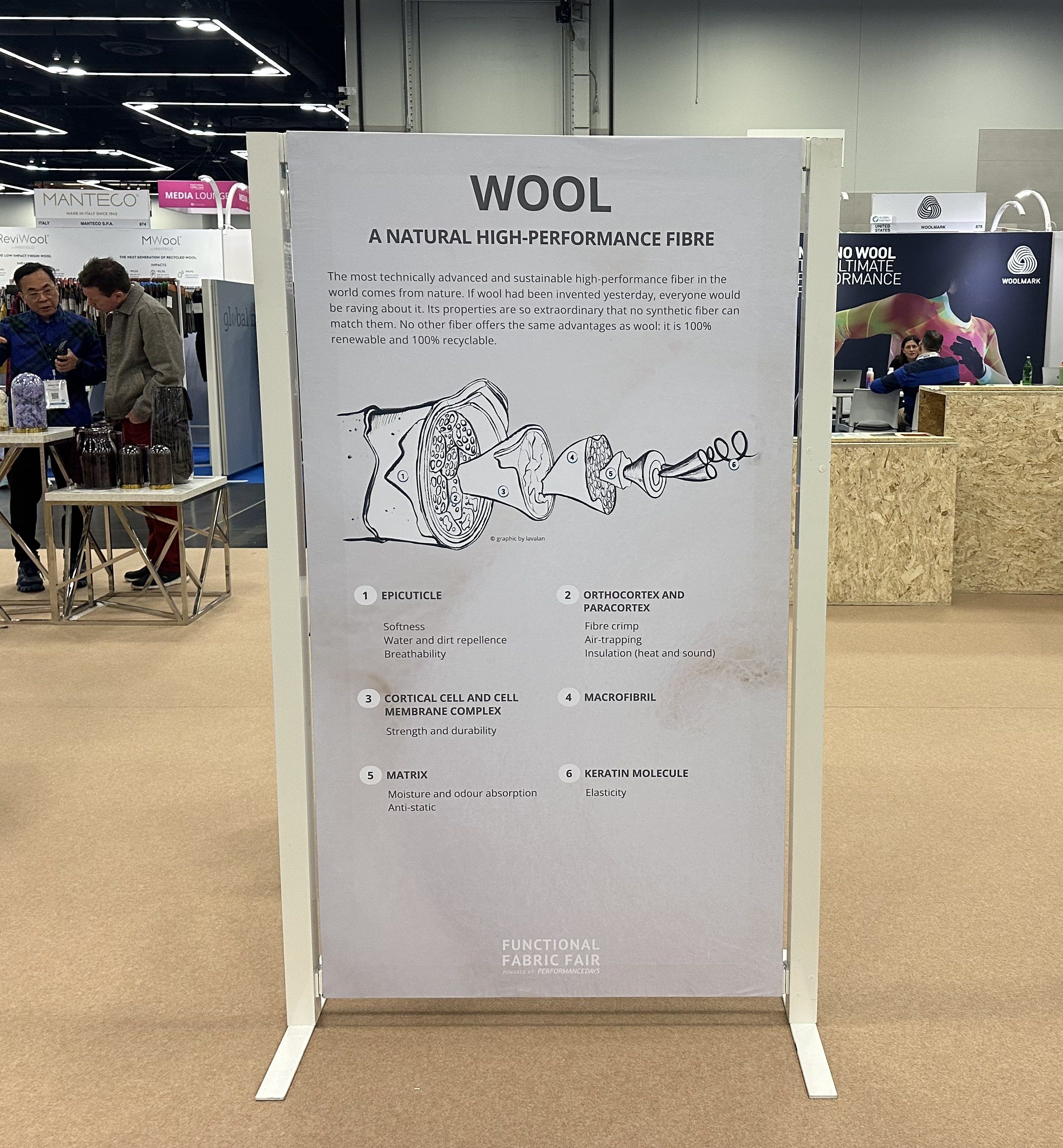
I took the above photo at the Functional Fiber Fair in Portland, where, to my delight, a whole section was devoted to wool education. Between this pic and an educational module from The Woolmark Company through their learning center1, I’ve pieced together the basics of what makes wool a wonder material.
1. Epicuticle: Made of tiny overlapping scales called cuticles, the outer layer of a wool fiber’s surface helps it repel liquid and resist abrasion. It’s what gives wool its softness, breathability, and dirt and water repellency.
2. Ortho-cortex and para-cortex: These cells form the core of a wool fiber and cause the coveted crimp or wave in the wool, which traps air and provides insulation. The more of a crimp, the better because it’s warmer.
3. Cortical cell and cell membrane complex: This acts as the fiber’s mortar to bind cortical and cuticle cells together, boosting strength and durability.
4. Micro- and macrofibril: Long filaments within the core of the wool fiber add more strength and resiliency. You’ll hear spinners say that longer fibers are better to work with, but the length also means the product lasts a long time.
5. Matrix: This part consists of high-sulphur proteins. Sulfur atoms attract water molecules, giving wool is absorbency. It’s why wool can absorb up to 30 percent of its weight in water.2 And it’s also responsible for resisting static and fire.
6. Keratin molecule: Coiled in a helical shape like a spring, these molecules give wool its flexibility, elasticity, and resiliency. When yarn is spun and knit together, wool garments stretch naturally—and then miraculously retain their shape.
How long have humans worn wool?
As I sit at my desk, I’m bundled in a wool sweater and beanie on my upper half, and cotton socks and canvas pants on my lower half. Let’s say I die while typing this and am buried in exactly what I’m wearing. (RIP me, but at least I’d be cozy.) In my casket, microorganisms would immediately get to work chomping away, first at fiber structures, and my wool and cotton garments would decompose off my skin in a matter of months, maybe a few years—long before my body.
That’s why whenever an archaeologist finds textiles at a site, it’s a BIG DEAL.
While the world’s first wool garments likely date back much earlier, these two discoveries—the Tarfan Man and Huldremose Woman—will blow your tiny mind.
Turfan Man’s Trousers
In 2014, a team from the German Archaeological Institute in Berlin entered a tomb in the Yanghai cemetery, a Bronze Age burial ground in the Tarim Basin in Northwestern China. This particular area is extremely dry and hot, and the Taklamakan Desert dominates much of the basin. On maps, it is a spot of sand. Summer temps there often get above 120 degrees F. (In folk etymology3, taklamakan means “once you enter, you cannot leave.”) The area has been of great interest to researchers since the 1970s because such intense conditions just so happen to preserve organic materials like human and animal remains as well as clothing and textiles. A perfect place to bury bodies—and clothing!
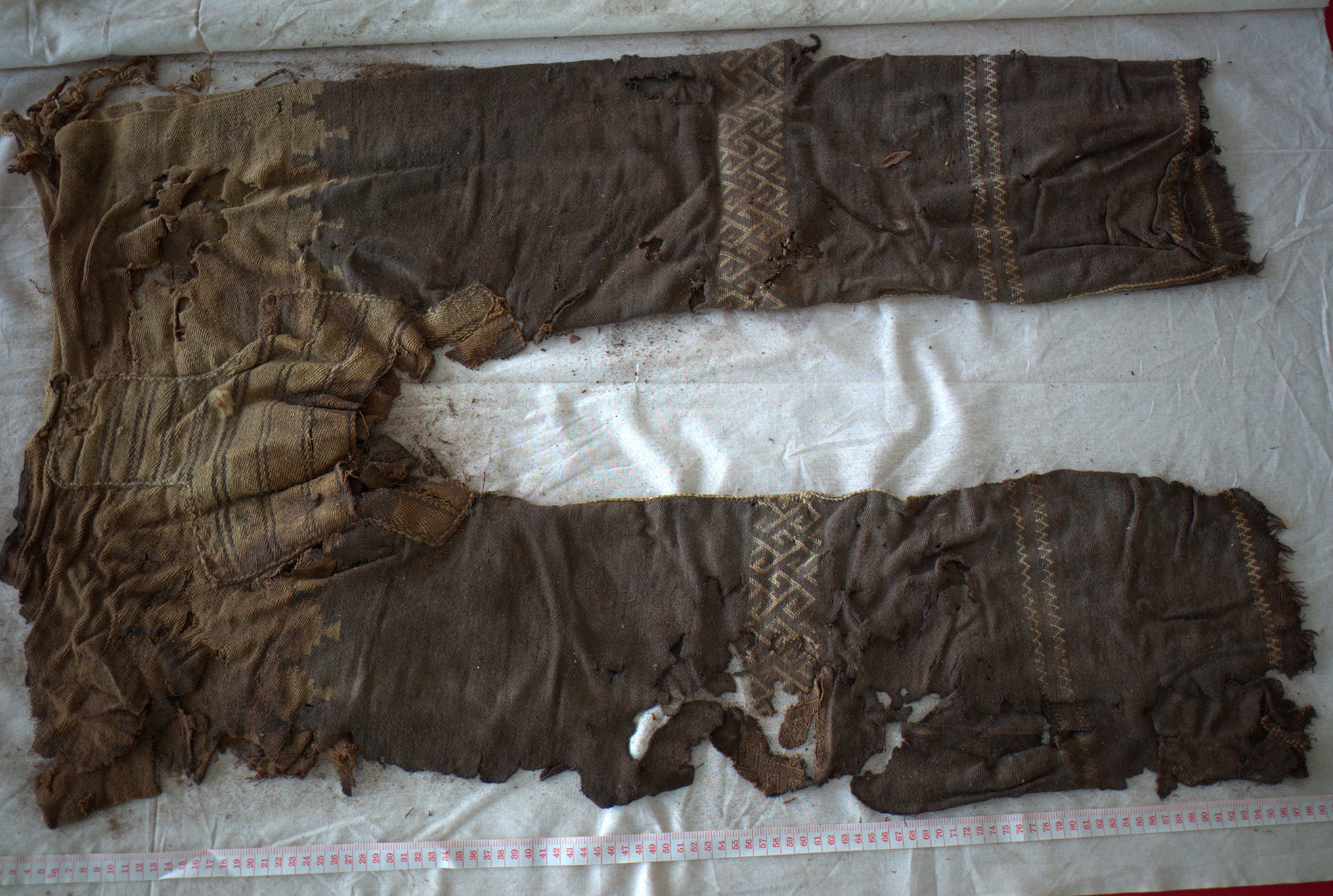
In researching the ancient peoples of the Tarim Basin, archaeologists came across a mummified body of a man, now called the Turfan Man because the site is near the Chinese city of Turfan. The man—actually, two men—was wearing a pair of trousers, and through radiocarbon dating, they found out that the clothes were made between the thirteenth and tenth centuries BC, or 3,300 to 3,000 years ago. These pants became notable as the oldest pants ever found that resemble modern trousers with separate legs and a reinforced crotch panel seen in riding pants4.
Our Turfan Man was also buried in a poncho belted at the waist, one pair of braided bands to fasten the trouser legs below the knees, another pair to fasten soft leather boots at the ankles, and a wool headband with four bronze disks and two seashells sewn on it. Historians think he may have been a horse-riding warrior because also had a leather bridle, wooden horse bit, and battle ax5.
Years later, in 2022, a study of those pants revealed that the trousers were “crafted from yarn made from course wool with a combination of three weaving techniques.” Much of the garment is a twill weave, which creates elasticity and flexibility to move freely. Variations in the weft—the horizontal threads interlaced through the vertical warp—created brown stripes over the crotch. Then zig-zag stripes were woven into the ankles and calves. And finally, tapestry weaving with twisted threads reinforced the geometric-patterned knees.
If all these different techniques and patterns have different origins, how did they wind up in this one garment? The diagonal designs, for example, also show up in pottery from Western Siberia and Kazakstan. And an even older twill weave was found in Austria’s Hallstatt salt mine.
Researchers believe that Turfan Man’s trousers reveal how ancient herding communities carried their traditions and knowledge across Asia, such as along the seasonal migration routes started 4,000 years ago in the Tarim Basin.
Questions still unanswered: What did the loom that made these pants look like? Who made them? Where did they live? And how did they learn to weave?
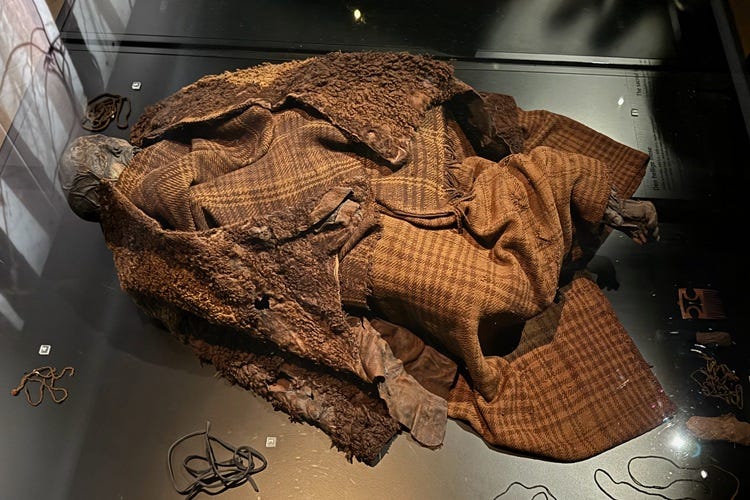
Huldremose Woman’s Cape, Scarf, and Skirt
More than 4,000 miles away in Denmark is another significant site. In 1879, a schoolteacher digging in a peat bog in Northern Jutland unearthed an unpleasant but significant discovery: the body of a woman6. But he didn’t know it was a woman right away. “There was a man that disappeared here in this area, some 10, 15 years ago. Could it be him lying in the bog?” poses Ulla Mannering, Research Professor in Textile Archaeology at the National Museum of Denmark on an episode of the Haptic & Hue podcast in 20257. Authorities were called to the scene, and the body was moved to a nearby barn for examination. But it’s not a local who had been murdered or gotten stuck in the peat bog. In fact, she wasn’t anybody that the schoolteacher nor the police would’ve ever encountered.
The body was one of hundreds buried in Danish bogs during the Iron Age, between 800 BC to 200 AD, nearly 2,000 years ago, believed by researchers to be human sacrifices to appease gods for fertility, protection, or after bad harvests. They believe these people died by strangulation, hanging, or stabbing. Then they were carefully placed in the bogs, where they were preserved in oxygen-poor, acidic water8. Just like in the Tarim Basin, the conditions were juuuuust right.
Named the Huldremose woman for the location of her burial site, she is among the most well-preserved bodies from that time. And unlike other bodies, she was found fully clothed. Back then, the doctor assigned to the case took all her garments home once authorities confirm it wasn’t a criminal investigation. And then the doctor’s wife washed the clothes and hung them up to dry, Mannering said in the podcast and wrote earlier in a 2010 historical report9. Imagine!
What do you know but some of these garments are made of wool—as well as plant fibers and animal skins—offering great insights into early Scandinavian textiles.
On her back are two layered sheepskin capes, both with an asymmetrical design and a slanting neckline. One cape has a patch that holds a fine comb made of bone, a thin blue hairband, and a leather cord, all wrapped in a bladder. “Clearly the patch cannot be interpreted as a pocket, as it had to be cut open in order to get the things out. The sewn-in objects have probably functioned as amulets.”10
Additionally, a wool scarf was placed around her head or neck, fastened with a pin made from a bird bone underneath the left arm. She also wore a long checked wool skirt, tied at the waist with a thin leather strap inside the woven waistband.
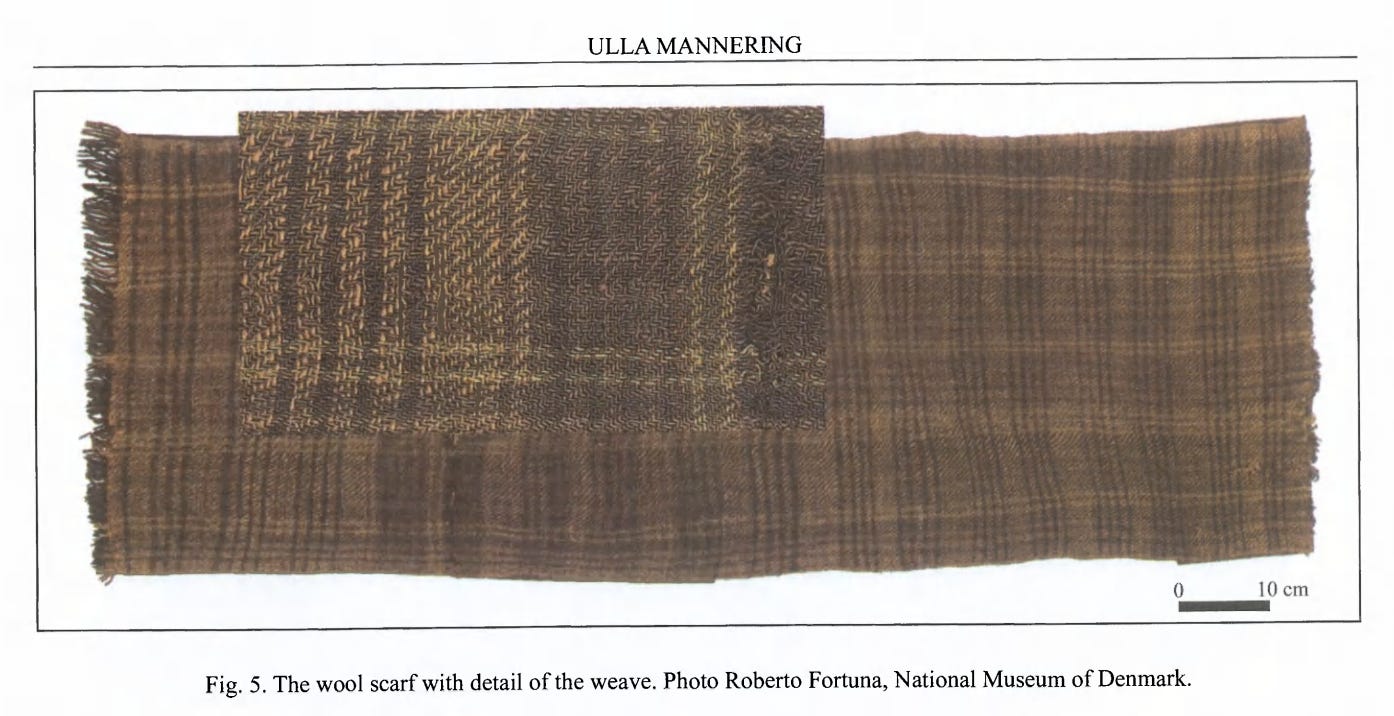
“A common feature of Pre-Roman Iron Age textile garments is that they are almost all finished on the loom and that they are rarely made from cut and shaped pieces. Only small alterations were made or added after the textile was taken off the loom. Clothes made from textiles were mainly draped or wrapped around the body and the legs, and fastened in various ways with cords or dress pins, as is the case with the Huldremose Woman,” Mannering wrote.
Through analysis, scientists at the National Museum of Denmark found that the skirt was originally blue or purple plaid, while the scarf was red plaid.
The Huldremose Woman and reconstructions of her clothing are on display at the National Museum of Denmark. I hope to get there someday.
For me, researching this chapter raised a lot of questions about wool patterns and methods. In a future chapter, I plan to look into the different types of wool textiles—like tweed—and the different ways to work with wool—like felting. Don’t worry, we won’t be stuck in time forever. In Chapter 3, we’ll speed things up to present day. See you then!
https://www.woolmarklearningcentre.com/
https://mountainmeadowwool.com/blogs/the-mmw-blog/the-anatomy-of-wool?srsltid=AfmBOooZXfP4qZEjYfZGY6oo_eUBI4r1dpcm66x3IAMmHhvxDyrujjuW
https://books.google.com/books?id=lRZwAgAAQBAJ&pg=PA16#v=onepage&q&f=false
https://www.thehistoryblog.com/archives/date/2014/06/02
https://www.sciencenews.org/article/pants-oldest-ancient-horseman-asia-culture-origin
https://berloga-workshop.com/blog/1153-huldremose-woman-jutland.html
https://hapticandhue.com/podcast-episode-62-bog-bodies/
https://en.natmus.dk/historical-knowledge/denmark/prehistoric-period-until-1050-ad/the-early-iron-age/the-woman-from-huldremose/human-sacrifices/
https://rcin.org.pl/dlibra/publication/35474/edition/22983/content
https://en.natmus.dk/historical-knowledge/denmark/prehistoric-period-until-1050-ad/the-early-iron-age/the-woman-from-huldremose/the-huldremose-womans-clothes/
I’m really enjoying this series, thank you Amelia. I had no idea that plaid was around thousands of years ago!
So good Amelia! That scarf is wild!